Complied by Hasmig Sarkissian Kevorkian
History
Embroidery is the mirror of the cultural heritage of a people; it reflects the traditions, customs and myths of this people and reveals its talents and resourcefulness.
Embroidery encompasses various types of stitches, patterns and lacework. It has been difficult to identify the origin and the age of many patterns because of the migration of the people from country to country and the interactions and mutual enrichment of cultures.
An ancient yet new art, embroidery is a global handcraft. Inspired by nature and using local raw materials, each country has developed its own unique embroidery type.
Despite being warriors, farmers, shepherds, and miners, the Armenian people has been a creator in all areas thus cultivating its culture through its creativity.
Embroidery was mainly reserved for the females; even the queens and the princesses were engaged in this art. All sorts of embroidery materials were made available for them to work with. They embroidered on brocades using wool, silk, cotton, gold, silver and other types of thread.
Girakos Gandzaketsi, a thirteenth-century Armenian historian from Artsakh, praised Arzu-Khatun, the wife of regional prince Vakhtang Khachenatsi, and her daughters for their expertise and skill in weaving. He had written, “ It was a marvel to those who beheld it…dyed with diverse colors and illustrated with images very precisely executed as if they had been carved, depicting the Savior’s incarnation and [lives] of other saints… Those who saw it would praise God for giving women the wisdom to produce tapestries and the genius of embroidery.”
Gandzaketsi also mentioned the altar covers depicting phases of Christ’s life made by Arzu Khatun and her daughters for Armenia's monasteries of Haghpat, Makaravank, and Dadivank. In addition, he wrote about Princess Khorishah Zakarian, sister of grand princes Zakare and Ivane Zakarian and the mother of Prince Hasan Jalal Vahtangian, and how after her husband’s death, she relocated to the holy city of Jerusalem, where she earned her living through her own embroidery work.
Women across Armenia engaged in embroidery and needlework, especially during foreign rules, when their former liberty was lost. The Armenian woman found emotional content in her needlework. With her work, she decorated churches and ecclesiastical attires. She used stones, beads, silk, and other threads to produce embroidered images of evangelists on chasubles, crowns, ephods, amices, stoles, gonfalons, and so on.
It was tradition for young girls to start preparing their dowry by sewing and stitching garments, beddings, lace collars, nightgowns, towels, pillowcases, tablecloths, scarves, and curtains using precious threads and domestic cotton and wool.
The following items were excavated from the Ancient city of Ani:
- Pieces of a girl’s garment, found in a tomb, which show high level of handicraft.
- The gonfalon of Gregory the Illuminator. One side of the banner depicts the Illuminator alongside King Dertad and St. Hripsime; the other side depicts the Christ. Preserved in the Echmiadzin Treasury Museum, the gonfalon is an exquisite piece of work made of silk and embroidered with cotton and silk threads.
The spread of Armenian Embroidery
Armenian embroidery was famous mostly in the cities of Ani, Vaspouragan and Daron of Western Armenia; in Marash, Urfa, Aintab, and other provinces of Cilicia; as well as in capitals of the region: Tbilisi, Constantinople, and Yerevan.
Unfortunately, Armenian embroidery had the same fate as other Armenian cultural values that were threatened to become extinct because of political events, particularly the 1915 genocide, deportation, plunder, destruction, and fires.
Bruno Eckart, a German operative at the Urfa carpet factory in 1910, was mesmerized by the patterns of Armenian embroidery and had asked Armenian photographers to capture those patterns from which an album as made. With the end of World War I, Bruno wished to return to Germany; however, his wife Satenig Bezigian not only refuses to go with her husband, she also forbade him from taking the album or any copies with him. She remarried, took the 230 patterns of Urfa embroidery to Armenia, and donated them to the National Gallery of Armenia.
After the 1895 genocide, American missionary, Corinna Shattuck, head of the American orphanage in Urfa sent the embroidery of orphan girls to the great German Armenologist, Dr. Johannes Lepsius who, in turn, established a workshop-orphanage and appointed Danish missionary, Karen Jeppe, as head in chief.
Meanwhile in Aintab, concerned about the preservation of the Armenian culture, Dr. Shepard and his wife sent Armenian embroidery to the United States and Europe. They also aimed at showing the world that the Armenians were a hardworking, creative and talented people.
Later, after the 1915 genocide, Armenian embroidery survived the genocide thanks to good-natured and diligent missionaries the likes of Karen Jeppe, Maria Jacobsen (the founder of Birds’ Nest), Sister Genevieve who encouraged embroidery and other crafts in the orphanages of Aleppo, Beirut, and Greece. Inspired by a charitable and patriotic purpose, these brave missionaries stood by the Armenian values and exported the handicrafts of the Armenian orphans to Europe and America.
After Sister Genevieve’s death in Lyon, her colleague and assistant, Leila Karagheusian gathered all the ornaments made by orphans from various regions of Greece, which Sister Genevieve had gathered to create a collection of Aintab weaving patterns. Karagheusian donated them to the St. Lazarus museum of the Mekhitarist Monastery of Venice.
The Sphere of Armenian Embroidery
The sphere of Armenian Embroidery ranges from the secular to the religious and the royal.
The social class, the villagers, embroidered on homemade fabrics or on calico while the wealthy embroidered complicated and delicate patterns on silk, and velvet with golden threads, beads, silk pearls.
Iconography
Flora
Patterns depicting plant life include pomegranates, pomegranate trees, grapes, clusters, cherry trees, lily patterns that are symbols of fruitfulness.
Fauna
Animal patterns such as the peacock, the nightingale, the swallow, and the dove are symbols of beauty, homesickness, construction, and peace.
Geometric Patterns
Geometric ornaments were usually architectural structures such as churches, Khachkars, tombstones aiming to immortalize the memory of the dead.
Heavenly
Armenian embroidery also features ancient religious symbols such as the Tree of Life, the solar symbol, and the Armenian Wheel of Eternity.
Armenian Alphabet
Armenian letters are embroidered also with a filling stitch.
Embroidery Types
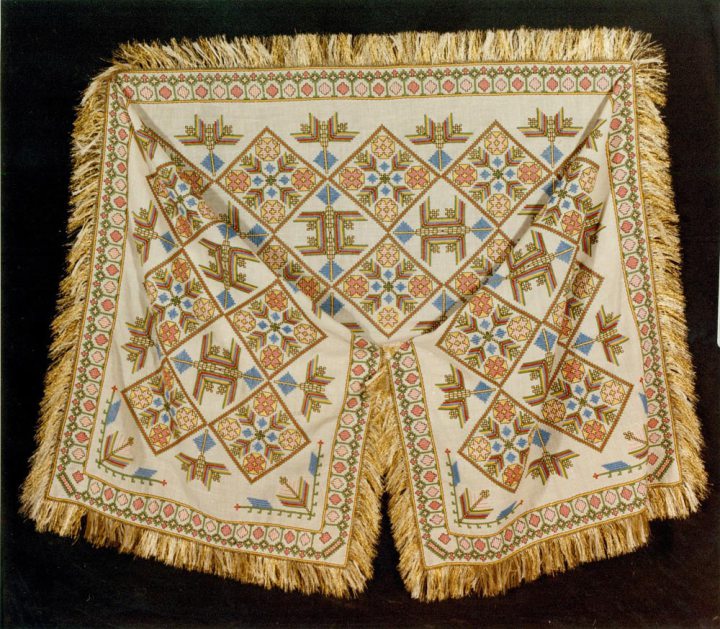
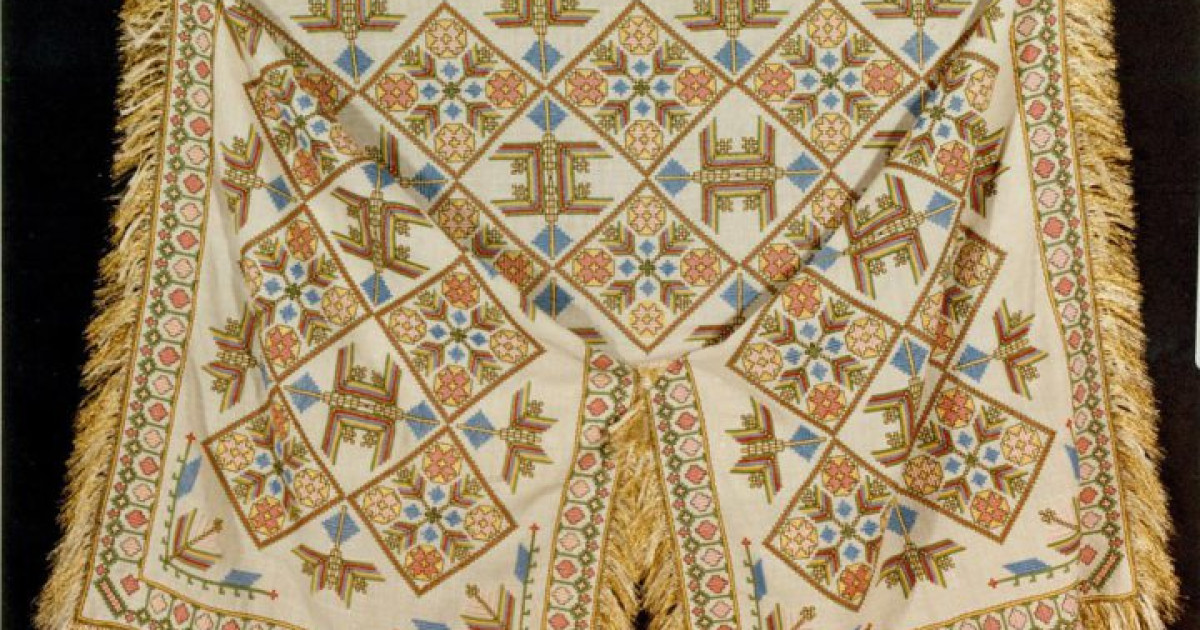
Armenian embroidery includes many stitches. Most used stitches are Embroidery stitch or “hartagar”, Buttonhole stitch, chain stitch, darning stitch, knot stitch, drawn-thread stitch, “Gotasegh”. The Armenian females also engaged in European textile arts such as crochet and applique. The used tools included needles, beads, tatting shuttle (makouk), and so on.
Each province had its unique embroidery, its unique embroidered garb. The festive costumes of the man featured almond-shaped patterns.
Over time, as lifestyles changed, fabrics changed as well; however, basic stitches and patterns remained the same.
The embroidery art is so vast that many schools of embroidery were established named after their respective geographic regions such as Aintab, Marash, Sivas. Embroidery indicative of these schools are kept in many museums across Armenia, the Levant, and Europe.
Armenian Embroidery Types
- Aintab Embroidery (Armenian Whitework)
- Marash embroidery
- Urfa embroidery
- Sivas embroidery
- Van embroidery
- Kilis embroidery
- Bolis embroidery or “Kazak”
- Sepasdia embroidery or “Tarsgar”
Various provinces of Armenia have their own special embroidery, which are generally used for ecclesiastical items used during religious rituals, such as chalice coverings, altar curtains, stoles, and so on depicting Christ, the apostles, and the evangelists.
Numerals, letters, and poetry quatrains were also embroidered and consequently transferred from generation to generation across the diaspora communities.
Certainly, we must not forget the fine and delicate embroidered needlework, lacework, and tattings of Moussa Dagh and Kessab that are still produced by Ainjar inhabitants.
Armenian embroidery today
And this is how Armenian embroidery was preserved throughout the ages and transferred through generations. Generally, the diaspora communities of Syria (Aleppo) and Lebanon are the ones who pursued this mission.
During the Lebanese civil war, when the economic situation was very bad, factories and schools were closed, the ARCL Regional Executive of the time conceived a wonderful idea, to unite women and girls, and to teach them needlework. They invited women who were well acquainted with embroidery to serve as teachers. When the number of employees went up, the ARCL opened a workshop, and with their well-organized work, they received their fair reward.
The ARCL Artisan aims at:
Preserving and spreading Armenian embroidery
Providing work for the females of the community
Providing income that will support the ARCL REB benevolent projects financially
Later, the scope of work changed and more embroidered items were being produced; this led to the opening of an artisan shop in the center of Bourj Hammoud where these beautiful creations are displayed. To organize the artisan related work, the ARCL REB also created an Artisan Committee.
Exhibitions are organized occasionally were Armenians and foreigners can enjoy Armenian embroidery, and appreciate and encourage the ARCL REB’s craft. Even when foreign or Armenian artists visit the showroom, they are filled with wonder and amazement. They express their adoration and appreciate of Armenian embroidery and its wonders, inciting hope for an enviable occupation.
21 November 2016, Beirut
Source: “Armenian Embroidery” Book by the ARCL