Yevnige Yacoubian
Armenian embroidery has been one of the richest ancient Armenian folk arts. From ancient times, needlework has been the Armenian woman’s favorite leisure activity. Cultivated for millennia, this art has passed from one generation to the next and reached us as embroidered pieces, remnants of clothes and blankets, as well as ecclesiastical ornaments.
Rich with its diversity, Armenian embroidery has developed in three main directions: public, commercial and ecclesiastical.
Armenian embroidery has a variety of patterns and stitches some of which are known in all places inhabited by Armenians while other patterns and stitches are local such as Sassoun, Moush, Marash, Van, Aintab, and Daros stitches.
Mothers mostly embroidered for their daughters’ dowries, starting while their daughters were still children. The engaged Armenian girl must have had ready for her dowry at least the following six pieces: sheet, cover and tapestry for her bed, square pillowcase, belt and wrapper for a baby.
In the cities of Cilicia, embroidery and carpet centers were established with the initiative of foreign missionaries. During the years between the two genocides (from 1896 until 1914), embroidery created by Armenian women were exported to Europe and the United States.
Provincial Embroidery
Each province has its unique embroidery or pattern that is named after the province such as Marash work, Aintab work, Urfa work, Sivas work, Vaspuragan work, etc.…
Aintab Embroidery
Aintab embroidery, or Armenian whitework, is a style of drawn thread work embroidery that is based on removing threads from a fabric and weaving a variety of patterns with those threads.
Marash Embroidery
Marash and the nearby settlements had been an important center of weaving and dyeing cotton and were famous for their embroidery.
Marash work is mentioned in Across Asia Minor on foot (1917) where we read: “You may notice also lengths of Marash linen in the making, and girls at work on the curious embroidery which bears the city's name.”
There are two types of Marash needlework: One is plain embroidery, which the people call “Atlaslama” or “Hartagar”; the other is lacework called “Irga” or “Kaghdnagar”.
A Scottish missionary, Agnes Salmond, who has served for many years in Marash’s orphanage, had written in her memoirs about the lacework produced by Marash girls and their great success abroad. She tells about the new building that was added to the orphanage where widows, poor women, and girls came to work and embroider.
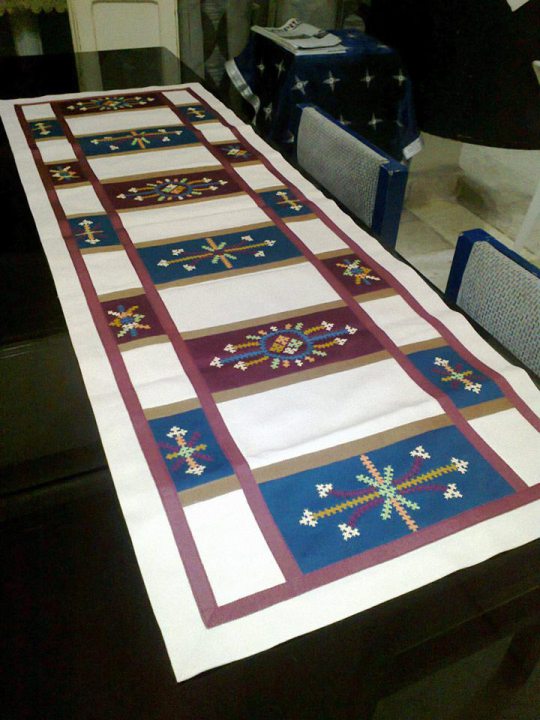
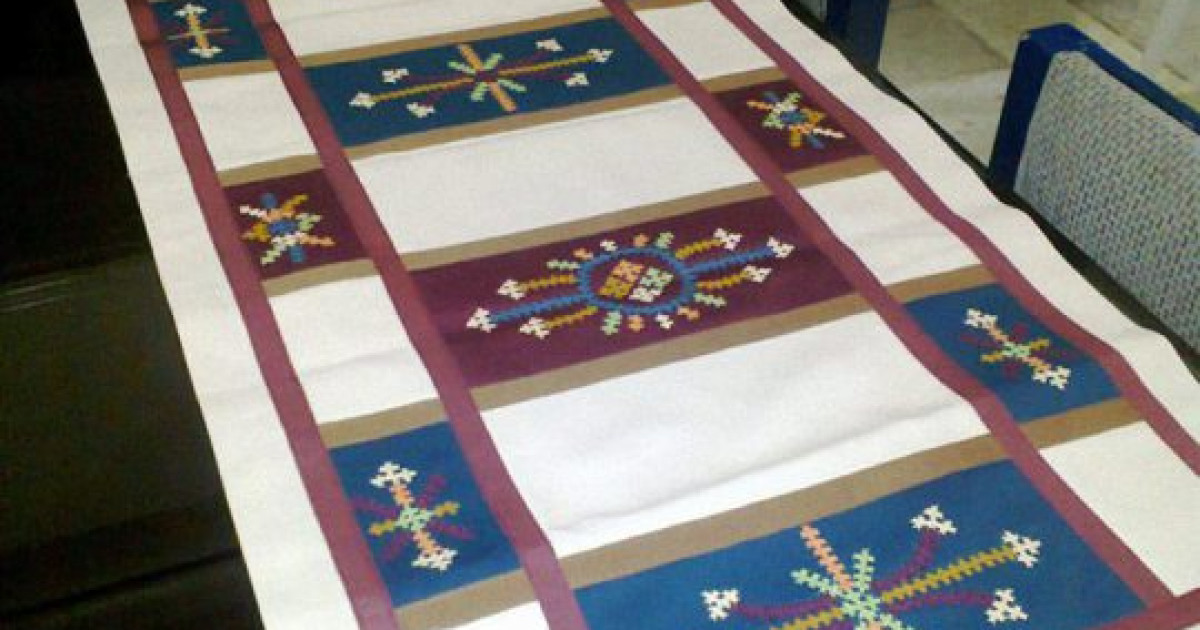
Marsh work has distinct patterns as well as unique motifs with peculiar names. It usually was emroidered with bright colored threads as well as gold and silver strands on dark backgrounds; however nowadays, milder shaded threads are used as well as light backgrounds made of various types of fabrics.
Marash work is also used in the preparation of ecclesiastical colthing and textiles.
Urfa Embroidery
Urfa work is called “Litsk” or darning; it looks like a painting. It is finalized with golden thread borders.
Sivas Embroidery
Sivas work is pure Armenian needlework based on counting-thread embroidery. Sivas work resembles tapestry and is currently embroidered on etamine.
Lacework
Lacework is one of the oldest and most difficult embroidery types. Being very delicate, it requires great skill and strained attention.
Caesarea Embroidery
Caesarea has been famous with its embroidery, an old trade and export. “Yazma” and “Maghagar” were among its famous embroidery types.
These are only some of many Armenian embroidery types…
“..the uprooted Armenians, willingly or unwillingly, endured on their skin and still bear the daily consequences of the cultural genocide. Our folk traditions were and still are the victims of the cultural genocide.”* as well as the craft of needlework which has recorded a great decline.
After the genocide, even in their tragedy, our grandmothers who settled in Aleppo and Lebanon continued to embroider their own needlework to secure their subsistence as well as prepare their daughters’ dowries.
“Women living in Beirut have also engaged in needlework. Not only to satisfy their personal needs, but also for sale, to secure a living. Thanks to their high artistic perfectness, the new products where valued as precious.”
(Satenig Davtyan in Armenian Embroidery).
Unfortunately, the following generations’ interests where diverted elsewhere for improvement of living conditions; thus, embroidery had started to record a decline in the Armenian homes. However, thanks to individuals and the great work done by the Armenian Relief Cross of Lebanon traditional embroidery is returning to the Armenian lives specially Marash, Sivas and Urfa work.
It is crucial to keep these traditions alive and transfer them to the subsequent generations "with the same solicitude that we inherited from the generations preceding us."
“The obligation to remain a traditionalist is not an end in itself. By merely clinging to our traditions, we can preserve our national identity through reinforcing our territorial belongingness.
(Zaven Zakarian in The Marash Work, Disappearing Traditions)
Used sources:
*The Marash Work, Disappearing Traditions by Zaven Zakarian (Aztag Daily, 21 June 2014)
Marsh Embroidery by Hradzan Tokmakjian (Allepo, 2010)
Armenian Embroidery by Satenig Davtyan (Yerevan, 1972)