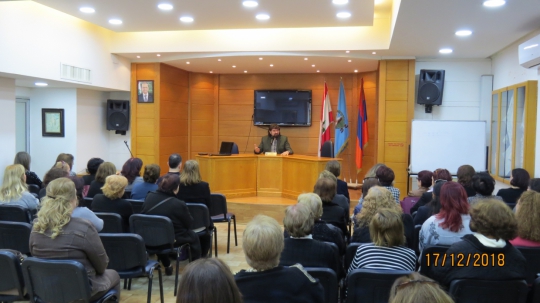
Under the auspice of the regional board, the organization of the educational committee of ARCL, and on the occasion of the 30th anniversary of the earthquake of Armenia a special lecture function took place in “Tenjoukian Hall” of Araxi Boulghourjian socio medical center on Monday, December 17, 2018.
After listening to the march of ARS, a short video was screened about the terrible earthquake in Armenia. Afterwards, Azniv Mikayelian gave the opening speech in the name of the educational committee. She noted that this committee has always been the torchbearer of cultural preservation and always strives to maintain our values and become a driving force for keeping the glories and customs of the past by promoting spiritual development. Then, Azniv Mikayelian talked about the destructive earthquake of Armenian which took place 30 years ago. She talked the official number of the victims, as well as the vast amount of assistance provided by the diaspora. She said that after 30 years from the earthquake, Gyumri is reviving again and the earthquake has become a mere scar in the memories. She invited the audience to stand one minute in silence in honor of the memory of the victms of the earthquake.
Afterwards, Azniv Mikayelian presented the biography and the activities of the lecturer Zakar Keshishian who is also a lecturer at the Lebanese National Higher Conservatory of Music, Haigazian University, and Hamazkayin’s Parsegh Ganachian Music College. He is also the Artistic Director of the “Varanta” Choir in Shushi, and The choirmaster of Hmazkayin “Gargatch”choir. Then, she invited him to talk about "The Armenian song, Gomidas. About the forthcoming 150th Anniversary of Gomidas”.
At the beginning of his lecture Zakar Keshishian talked about the reason of his being in Armenia during the earthquake, and his testimony. He said that as they went to Gyumri after the earthquake they saw tremendous scenes, however, the positive aspect was that they were going to Gyumri as students of the Yerevan State Conservatory to give homeless families and children comfort and solace with their concerts. One day, when they went back to Gyumri with some of his classmates to present a concert for 100 hundred students in a tent, they saw a boy crying. At the end of the concert Keshishian approached the little boy and asked the reason why he was crying. He understood that the boy had an instrument “shvi” which was lost under the ruins. Zakar Keshishian gave the boy his own “shvi”. Years later, the lecture’s aunt heard from the radio station of Yerevan that the boy who was crying became a famous “shvi” player thanks to the “shvi” gifted to the boy by Zakar Keshishian. Then the lecturer touched upon the current situation of the Armenian song and stated that unfortunately the new generation doesn’t know the famous Armenian titan of music Gomidas. Then, hinting to the audience, he said that some of them surely know the songs of Gomidas. But each one of us should know ten songs at least, 10 songs of Gomidas in order to remain Armenian. We should teach the new generation the songs of Gomidas. Then he referred to the biography of (Master) Gomidas “Vartabed”, his accomplishments and death, saying that he had been prosecuted enormously in Echmiadsin as well as in Bolis “Costantinople”. He talked about the lecture where Gomidas presented the subject “The Armenians have their own music” to foreigners. This is the bible of the Armenian music where Gomidas explains the uniqueness of the Armenian music constructed on musical bases. The quartets and the hymns composed by Gomidas were also persecuted by contemporary and fellow monks. He wanted to leave the congregation, but their refusal forced him to go secretly to Constantinople where he established the “Kusan” choir. Magar Yegmalian was his instructor. In Costantinople, Gomidas collected songs sung by the people, however, most of them remain lost. Whatever is left to us by Gomidas makes up the certificate of the uniqueness of the Armenian music. Zakar Keshishian talked about folk songs and said that not every song is a folk song. The songs that the people sing are considered folk songs. In this regard, Gomidas has listened to the songs of the people and has extracted the notes of those songs. He also said that if it wasn’t for Gomidas the songs would have been forever lost. He was the savior and the author of the national music system. He is a genius in the Armenian reality who immortalized the Armenian music. If the Armenian Genocide didn’t occur, he would have composed more. Then the lecturer made the audience listen to a song named “loru Gotan” recorded by Gomidas's voice and choral performance through which the audience witnessed the greatness of Gomidas. Then he mentioned that the folk songs are so accurate and through them we see the true spirit and the character of our nation. Then the lecturer indicated that foreigners appreciate the jewels of the Armenian song and Gomidas more than we do. Zakar Keshishian mentioned that next year is the 150th birth anniversary of Gomidas, and hoped it would be a convenient occasion for the younger generation to return to their national roots, and that the musical root is one of the most important and strong roots of the Armenian nation.