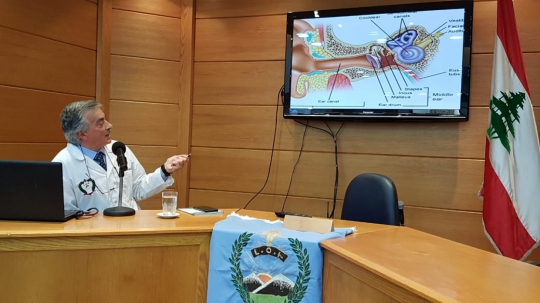
The tenth lecture of the series of lectures organized by the Health Committee of the Regional Board of ARCL took place on Wednesday, April 3, 2019, “Hearing Disorders and Reasons of Dizziness”.
After listening to the march of ARCL, the opening word was read by Dr. Siroun Vartabedian the chairperson of the Health Committee of the Regional Board of ARCL. She talked about the importance and role of hearing and the health issues related to it. Hence, Dr. Katchig Panossian was invited to talk about all these matters.
Dr. Khatchig Panossian talked about the anatomy of the ear and the disorders of hearing. The ear is composed of three parts: inner, middle and outer parts. The middle part starts with the visible portion of the ear which is the ear conch from where the outer tube of the ear goes inward to the eardrum. The middle ear which start with the eardrum and the has the three smallest bones of the body: the hammer, the anvil and the stirrup. There is a canal in the middle ear which connects the ear to the nose. The inner ear is made up of a helix, in which there are organs and thin hair cells that transmit waves of hearing to the nose and reach the brain thus we begin to hear. But the ear is not only hearing, it is also balance. There are semi-spiral tubes in the inner ear, there are hair-like cells and there are nerves which are called balance nerves. The hearing and the balance route reach the brain from one cavity. It’s the same center, one next to the other. When we have a balance problem, this means that there are hearing problems because they go in the same tube. He said that the main reason of dizziness is the disorder of that nerve especially for grown-ups. When nerve degeneration starts, this doesn’t mean that there is only deterioration in the ear but also deterioration in the brain and disorder in the balance.
Dr. Khatchig Panossian divided the listening disorders into two categories: the first one is congenital and the second is acquired. The congenital hearing disorder is present from the day a person is born, but the acquired hearing disorders are aspects that may happen during one’s lifetime. In case of congenital hearing disorder, the child may be totally deaf, or partially deaf, where there may be partial hearing. A totally deaf child would have a very difficult life. In the absence of outer and middle hearing the child would be totally deaf, and in that case he/she would be called deaf and mute. There is a sphere in the ear conch where the bottom is empty. The baby hears from the day he is born and recognizes his mother’s voice. When the baby doesn’t look to the direction of his mother’s voice then the help of a specialist should be sought. There is a special method to test the hearing of a newborn called EPA (Evoked potential audiogram): a medication is given to the baby, the baby falls asleep and electronic wires are attached to his head and they monitor how much the baby hears. According to this they decide whether to treat the hearing or not? How to treat it? Through operation or by using external hearing apparatus? However, this operation is done on the account of the Health ministry. As for the acquired disorder it is resulted from the earring, ear wax. Ear wax is a natural substance, that is produced by the outer ear in order to kill the microbes or the bacterium, the microbes that come from outside. Its functions are to protect and moisten, moisten the outer ear pipe, so that cracks aren’t made, and the bacterium aren’t able to enter the ear and cause inflammation. In case of excess secretion, it may obstruct the hearing cannel. It is not right to clean the ear with cotton swaps because it could cause damages: We are drying the cannel artificially, microbes enter the ear and cause inflammation. And in case of puncturing the ear drum, we are facing other problems. The problems of the outer ears are caused by foreign bodies, such as insects. In this matter we shouldn’t clean the ear, but we should bend the head and drop few drops of oil to the beginning of the tube for couple of minutes until the insect dies. Then seek the help of a doctor. Other than insects there could be small spheres. In case of foreign bodies, we shouldn’t try to take them out with metal bodies and means because these could give way to bigger issues. In case of middle hearing problems there are acute middle ear inflammations. This could happen when the person has cold, and the inflammation of the nose could cause middle ear inflammation and the tube is obstructed. In this sense, the tympanic cavity behind the ear drum is filled and pushed. We should directly see a doctor. Meanwhile, take some Dorexina or Panadol as painkillers. In case of postponing, the inflammation may puncture the eardrum, which could reach to the brain. For this reason, there are people who have middle ear chronic inflammation.
Then Dr. Khatchig Panossian talked about ear and nose disorders in children. This starts with extra meat in the nose. This is not found with grown-ups. Sometimes children with extra meat in the nose get ear inflammations behind the ear drums. This is not pus but clear inflammatory fluids which cause hearing disorders. After examination, the doctor does an operation where the extra meat is removed, and a cannel is made under the eardrum, an artificial tube is inserted which is removed later on, and the child has normal hearing. As for grown-ups the middle ear disorder could be caused by the calcification of the stirrup. And this happens especially to women after menopause. In case of inner ear there is the nerve degeneration. Nerve degeneration starts at the age of 50-55. Degeneration is caused by several factors such as naturally age related degeneration, or unnatural diseases caused by the atmosphere, noise, reasons related to the environmental issues. Our lifestyle, exercise/sports, and yoga are very important. Then he listed devices found in the ARCL center to measure hearing and diagnose degeneration, after which the individual should see a doctor so that exact diagnosis is given. To the age of 70 an individual should take audiometry for once, and after 70 the test should be done twice. The individual should definitely use hearing apparatus. Dizziness is not a disease but a symptom. Any disorder in the bodily organs could lead to dizziness. First, the signs and major organs should be tested. Dizziness could be caused by muscular, digestive, urinary, as well as gland disorders. Blood hypertension should be tested regularly.
Then the doctor talked about blood crystals. Crystals are accumulations of salt that turn to liquids. When these crystals join they form huge masses and obstruct this or that vein and cause dizziness. This is BPPV (Beny positional paroxysmal vertical) the disorder of crystals. The doctor gives medication, and can detect which veins are obstructed by the hand and head movements of the patient. After the tests, repositioning is done by the doctor through the head movement. Repositioning of that complex is called Eplis Malor which is a big discovery in the given field.
At the end of the lecture the attendees asked questions to the lecturer. In the name of the Health Committee a souvenir was given to the lecturer of that day Dr. Khatchig Panossian.
Then Dr. Alina Keshishian talked about The International Day of Meningitis which coincides in April.